
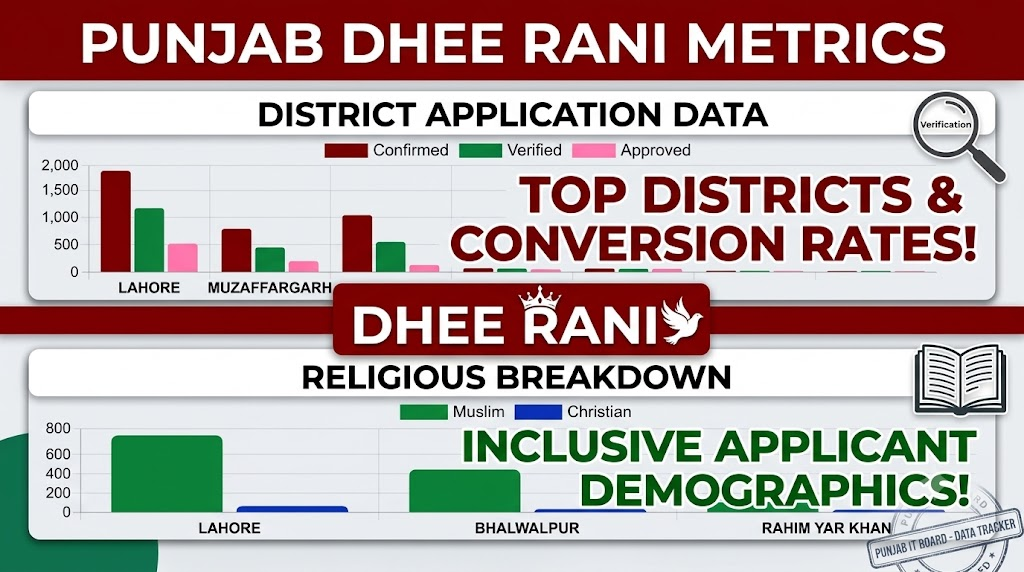
The Chief Minister Punjab Dhee Rani Programme (Collective Marriages Programme) stands as a prominent social welfare initiative designed to support financially vulnerable families across Punjab. By facilitating dignified mass wedding ceremonies, the government aims to relieve the extreme financial burdens faced by underprivileged parents.
To maintain complete transparency and operational efficiency, the Punjab IT Board (PITB) tracks real-time registration data across all 36 districts. Based on the official statistical visualizations found in image_83d422.png, this comprehensive guide analyzes the regional distribution of applicants, the validation pipeline, and the demographic breakdown of the program’s target demographic.
Technical Overview of the Application Processing Workflow
The program’s administrative workflow is divided into three major stages to ensure that government funds reach genuinely eligible families:
- Total Confirmed Applicants: The initial pool of candidates who completed and submitted their formal digital applications through the official online portal.
- Verified Applicants: Candidates whose documentation, socioeconomic status, and residency constraints have undergone thorough physical and digital scrutiny by the localized Social Welfare Department teams.
- Approved Applicants: The finalized list of couples officially selected to participate in the upcoming collective marriage ceremonies and receive the provincial financial endowment packages.
District-Wise Application Progress & Registration Dynamics
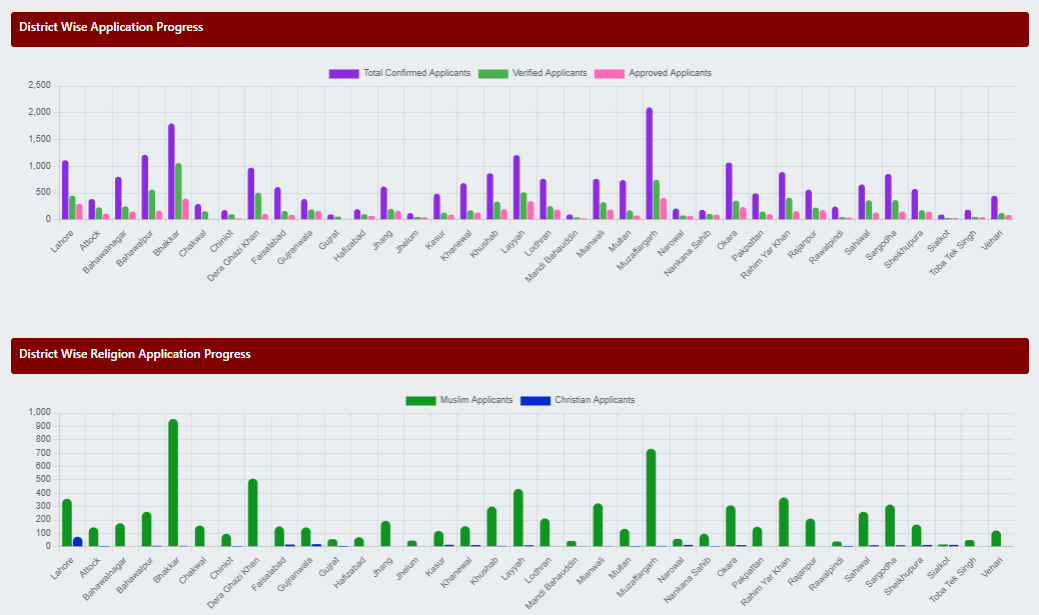
The data from the primary dashboard chart reveals a significant variation in registration volumes between different districts, reflecting varying local population densities and economic needs. Highly populated regions and specific districts within South and Western Punjab show the highest concentration of applicants.
Statistical Summary of District-Wise Registration & Verification
The table below presents a structured extraction of the application progress metrics across the participating districts as visualized in the official performance metrics of image_83d422.png:
| District Name | Total Confirmed Applicants | Verification Status & Regional Insights |
| Bhakkar | ~1,800 | Highest overall registration pool; shows exceptionally high conversion to verified status (~1,000). |
| Muzaffargarh | ~2,100 | Leading district in total volume of initial submissions with strong verification tracking. |
| Layyah | ~1,200 | Strong rural enrollment with a high proportion of validated candidate profiles. |
| Bahawalpur | ~1,200 | Major administrative hub in South Punjab displaying consistent application processing. |
| Lahore | ~1,100 | Prominent urban center with balanced distribution across minority and majority groups. |
| Okara | ~1,050 | Substantial provincial engagement showing progressive verification metrics. |
| Dera Ghazi Khan | ~950 | High economic necessity driving substantial submission metrics in the region. |
| Khushab | ~850 | Steady rural engagement with consistent verification processing. |
| Sargodha | ~600 | Moderate registration profile with regular validation updates. |
| Faisalabad | ~600 | Key industrial division showing steady submission counts. |
| Jhang | ~600 | Moderate turnout reflecting balanced regional mobilization efforts. |
| Rahim Yar Khan | ~850 | Significant South Punjab registration footprint with stable processing. |
| Sahiwal | ~650 | Central Punjab division maintaining uniform processing rates. |
| Mianwali | ~750 | North-Western district exhibiting strong local enrollment metrics. |
| Multan | ~700 | Primary urban center of South Punjab with consistent metrics. |
| Lodhran | ~750 | Active registration metrics matching surrounding territorial dynamics. |
| Attock | ~400 | Balanced northern territory engagement with controlled entry fields. |
| Bahawalnagar | ~800 | High agricultural belt response showing significant baseline numbers. |
| Chakwal | ~300 | Lower demographic density contributing to a smaller candidate pool. |
| Chiniot | ~150 | Limited registration volumes undergoing administrative validation. |
| Gujranwala | ~400 | Industrial cluster showing concentrated, verified urban demand profiles. |
| Gujrat | ~100 | Low baseline turnout reflecting higher localized average household income tiers. |
| Hafizabad | ~200 | Smaller geographical sector showcasing selective target audience capture. |
| Kasur | ~500 | Border-district profile with linear progress across all verification vectors. |
| Khanewal | ~700 | Steady agricultural sector hub exhibiting regular verification indicators. |
| Narowal | ~150 | Northern border district showing baseline administrative response indicators. |
| Nankana Sahib | ~150 | Specialized district tracking balanced communal inclusion vectors. |
| Pakpattan | ~500 | Moderate agrarian hub enrollment with strong processing curves. |
| Rajanpur | ~550 | High-priority development region showing solid engagement levels. |
| Rawalpindi | ~250 | Upper tier northern metropolitan sector with low relative baseline necessity metrics. |
| Sheikhupura | ~100 | Controlled registration volumes processing through standard channels. |
| Sialkot | ~50 | Lowest relative regional applicant volume captured across key major divisions. |
| Toba Tek Singh | ~150 | Moderate internal structural processing with standard conversion rates. |
| Vehari | ~450 | Solid baseline South Punjab entry showing stable departmental vetting. |
Religious Demographics and Inclusive Social Welfare Metrics
The second analytical visual from image_83d422.png, titled “District Wise Religion Application Progress”, highlights the program’s non-discriminatory approach. The dashboard explicitly tracks allocations for both Muslim and Christian applicants to ensure equitable resource distribution.
Key Demographic Observations:
- Dominant Segments: Muslim applicants form the largest percentage of participants across all districts, with the highest single concentration recorded in Bhakkar (approaching 1,000 active instances) and Muzaffargarh (exceeding 700 active instances).
- Minority Inclusion: Minorities, specifically Christian applicants, show measurable registration footprints in specific urban and industrial corridors. Lahore shows the most prominent minority enrollment profile on the dashboard, followed by minor indicators in districts like Faisalabad, Kasur, and Sialkot.
Also Read More About: CM Punjab Dhee Rani Programme
Official Web Links and Portals
To learn more about the program’s rules, check active verification statuses, or read official announcements, please visit the authorized provincial platforms:
- Primary Social Welfare Hub: Social Welfare and Bait-ul-Maal Department, Government of Punjab
- Provincial Tracking Framework: Punjab Government Official Information Portal
Frequently Asked Questions (FAQs)
Q1: What do the different colored bars signify on the application progress dashboard?
As shown in image_83d422.png, the purple bars represent the Total Confirmed Applicants who successfully submitted their profiles. The green bars display the Verified Applicants who cleared initial departmental screening, and the pink bars indicate the finalized Approved Applicants selected for the marriage ceremonies.
Q2: Why do districts like Bhakkar and Muzaffargarh show significantly higher numbers than Lahore or Sialkot?
Registration volumes are closely tied to regional demographics and economic needs. Districts with larger rural populations and lower average household incomes, such as Bhakkar and Muzaffargarh, show higher registration numbers compared to industrialized or high-income areas like Sialkot.
Q3: How does the program ensure the inclusion of religious minorities?
The Punjab government tracks applications by religious demographic, as seen in the District Wise Religion Application Progress chart. This tracking helps ensure that minority communities, particularly Christian families in urban hubs like Lahore, receive fair access to the program’s benefits.
Q4: What is the next step for an applicant after moving from ‘Verified’ to ‘Approved’?
Once an applicant’s status shifts to Approved, they are officially cataloged into the upcoming collective marriage event schedule for their respective district. The localized Social Welfare office then contacts the family to coordinate event logistics, guest counts, and the delivery of household down-payments or dowry gifts.